
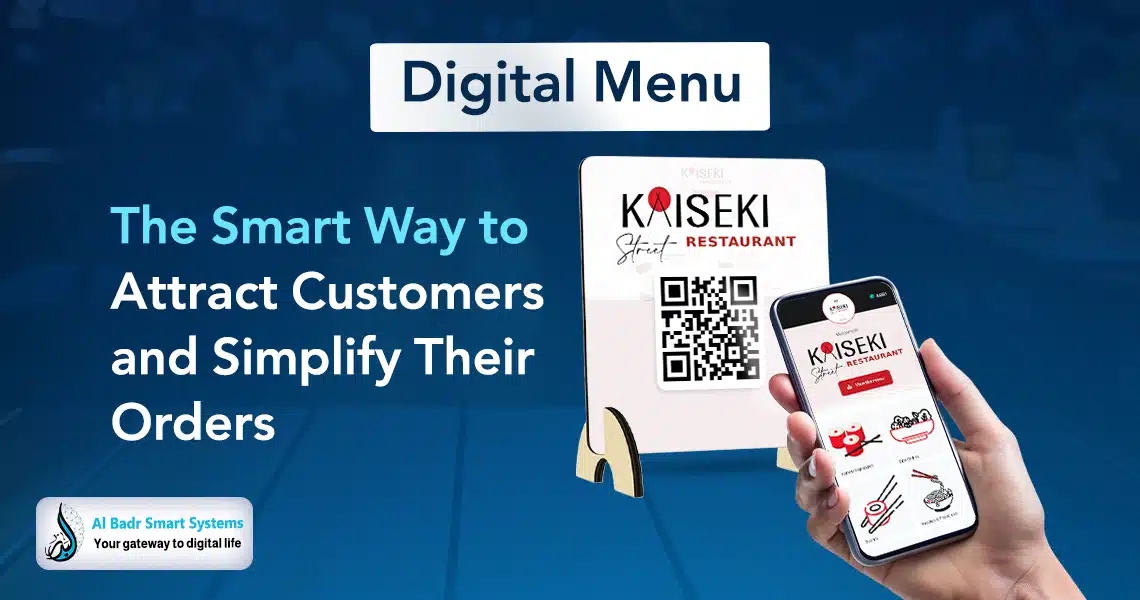
Have you ever asked yourself why certain restaurants succeed in attracting customers and securing repeat visits? The secret lies not only in the quality of the food but also in providing a seamless dining experience. A digital menu is the cornerstone of this process. It grants your customers speed, privacy, and the ability to make smart selections directly from their personal smartphones, making your business future-ready with a simple touch of technology.
What is a Digital Menu?
Some believe that a digital menu is merely a PDF file uploaded by the restaurant owner online, but the reality goes far beyond that.
Defining a Digital Menu and How It Differs from Traditional Menus
A digital menu is a smart, interactive platform explicitly engineered to fit smartphone screens. It is accessed by scanning a QR Code placed on the dining tables. The difference between it and a traditional paper menu is vast:
- Flexibility: Paper menus are rigid. If you want to alter a price or delete an item, you must reprint everything and incur ongoing costs. Conversely, a digital menu can be edited in seconds.
- Interaction: A digital menu allows customers to view high-quality photos from different angles, read complete ingredients, and click buttons to place orders instantly. Meanwhile, paper menus remain silent and restricted by physical space.
- Continuous Costs: Paper menus drain a recurring budget for printing and laminating. A digital menu is a smart, long-lasting investment that serves you continuously at a minimal cost.
Features and Strategic Uses in Restaurants
This system has become the backbone of modern restaurants due to the practical solutions it provides.
10 Technical and Operational Advantages
- Immediate Cost Reduction: Eliminates the continuous budget allocated for paper printing and premium leather covers.
- Instant Price Adjustments: Update prices via a single click from the dashboard to keep up with market fluctuations.
- Multi-Language Support: Display your digital menu in Arabic, English, and other languages to serve tourists and foreign residents perfectly.
- Engaging Visuals: Add an image gallery for each dish to stimulate the customer’s visual appetite.
- Health Standards: Reduces physical contact with surfaces, providing a safer environment for guests.
- Accurate Ingredient Lists: Protect allergy-prone diners by explicitly stating the components of each dish.
- Smart Inventory Management: Hide out-of-stock items immediately to prevent front-of-house staff embarrassment.
- Data-Driven Marketing: Analyze customer preferences by tracking the most viewed items on the platform.
- Ultra-Fast Loading: Our system at Al-Badr is engineered to load rapidly even under weak internet connection speeds.
- Effortless Distribution: Share your digital menu link instantly via WhatsApp or embed it in your social media profiles.
10 Innovative Ways to Deploy Your Menu
- Place QR Code stickers on dining tables for seamless dine-in ordering.
- Provide QR codes on restaurant windows to facilitate drive-thru ordering.
- Utilize the digital menu link as an official, unified listing for home delivery services.
- Display the interactive menu on large touchscreen monitors in waiting lounges.
- Embed the digital menu into your Google Maps profile to attract nearby foot traffic.
- Dedicate special sections within the layout for daily deals or “Happy Hour” promotions.
- Use the platform to collect immediate customer feedback right after their meal.
- Display nutritional values and calorie counts to assist health-conscious diners.
- Provide a digital “Customize Order” option (e.g., extra sauce, no onions).
- Leverage it as an internal training tool for new staff to memorize dishes and ingredients quickly.
How Does a Digital Menu Simplify the Ordering Process?
Simplifying transactions is the core purpose behind this system. But how does it work correctly in practice?
- Instant Access: As soon as customers sit down, they see the QR code. They do not need to download an application or register an account; they simply open their smartphone camera, and in less than two seconds, your digital menu appears. This completely eliminates the waiting time for a waiter to bring a physical booklet.
- Structured Browsing: The digital menu is divided into clear categories (appetizers, grills, beverages). Customers swipe through them effortlessly, viewing large, crisp photos that mirror the true quality of your cuisine.
- Cart Personalization: Diners add their desired items to the “Order Cart.” This is where the notes feature becomes crucial; they can type specific modifications to a dish, ensuring the order reaches the kitchen exactly as wanted.
- Automated Dispatch: After reviewing the itemized summary and total price, the guest clicks “Submit.” The request is dispatched instantly and automatically to the cashier screen and kitchen display, bypassing human error, misunderstandings, or forgotten ingredients.
Enhancing Customer Experience with a Digital Menu
Improving guest satisfaction begins by making the customer feel that their time is valued. A digital menu achieves this through multiple avenues:
Stress-Free Decision Making: Many diners prefer making choices calmly without a server hovering over their table. A digital menu grants them the necessary time to browse, look up details, and compare items seamlessly.
- Financial Transparency: Customers see the total cost of their order—inclusive of taxes or service fees—before confirming it. This transparency builds high trust between the customer and your establishment.
- Visual Upselling: High-resolution, professional photos make diners feel confident in their choices and prompt them to try additional items, driving indirect upselling effortlessly.
- Reduced Friction: Fast ordering cycles reduce the overall time spent waiting for service, which directly improves the consumer’s aggregate rating of your venue.
Integrating Your Digital Menu with POS Systems
Technical integration is what sets Al-Badr Smart Systems apart. A digital menu is not an isolated tool; it operates as an integrated module within a larger ecosystem:
- Real-Time Synchronization: When a client submits an order via the digital menu, it registers automatically on your Point of Sale (POS) system as a new transaction, complete with table numbers, timestamps, and custom notes.
- Automated Stock Depletion: Upon order confirmation, the system deducts the utilized ingredients from your inventory automatically. This grants restaurant management an accurate, live view of warehouse stock levels at any given moment.
- Rapid Billing and Checkout: As soon as guests finish dining, their invoice is ready on the cashier dashboard without requiring manual data re-entry. This accelerates payment processing and prevents bottlenecks at the exit.
Boosting Productivity and Reducing Errors
Transitioning your restaurant to a digital framework increases operational efficiency through measurable metrics:
- Eliminating Order Errors: The bulk of restaurant complaints stem from incorrect order taking. With a digital menu, the customer handles the selection directly, pushing the margin of error down to nearly zero.
- Optimizing Staff Allocation: Instead of waitstaff spending 70% of their shift delivering menus and manual recording, they focus entirely on table hospitality, cleanliness, and engaging with guests, which elevates your service standard.
- Accelerating Table Turnover: Shorter ordering and checkout cycles mean tables are cleared and prepared for new guests much faster. This increases your daily seat utilization without needing to expand your physical dining area.
- Managing Expectations: By displaying the approximate preparation time for each dish on the digital menu, you manage customer expectations effectively, reducing perceived wait-time boredom.
The Future of Digital Menus: Augmented Reality (AR) and AI
We are on the verge of a hospitality revolution where the digital menu evolves far beyond basic images and text:
- Augmented Reality (AR): Imagine a customer pointing their phone at an empty table and seeing a life-sized, 3D model of a ribeye steak before ordering it. This technology is already emerging, attracting tech-savvy demographics and diners seeking premium, memorable experiences.
- Artificial Intelligence (AI): Future setups will analyze browsing habits. If a user is vegetarian, the digital menu will intelligently highlight plant-based options the moment it opens, or suggest a specific beverage that pairs perfectly with their selected entry.
In upscale dining districts, such as “Via Riyadh” in Saudi Arabia, AI technologies are being integrated with digital menus to deliver hyper-personalized experiences. The system recognizes returning guests, welcomes them, and presents a tailored list based on their historical preferences.
Dining turns into an enjoyable tech journey, and we at Al-Badr aim to bring these international standards to your business, regardless of its scale.
Driving Up Average Order Value (Upselling)
One of the greatest commercial secrets of a digital menu for restaurants and cafes is its ability to act as a silent, smart marketer. On a paper menu, a customer might only select a main course. However, on an interactive digital platform, you can program contextual recommendations to trigger during checkout.
For instance, when a user selects a “Burger,” the digital menu automatically suggests adding crispy fries, a soft drink, or an extra slice of cheese for a nominal fee.
Displaying these enticing images exactly when the customer is hungry prompts them to add items they had not planned on ordering. This increases the average order value by up to 20% without requiring extra effort from your service staff.
Building Customer Databases and Target Marketing
The utility of a traditional menu ends the moment a guest exits your doors. A digital menu, however, marks the beginning of an ongoing relationship. Through the platform, you can offer customers the option to leave a review or join a loyalty list by inputting their WhatsApp number or email address.
This data is a goldmine for business owners. You can later dispatch promotional campaigns detailing new discounts or alert patrons about newly introduced dishes. This integration converts one-time visitors into loyal, recurring clients, maximizing retention and brand attachment.
FAQ Regarding Digital Menus
What are the primary benefits of a digital menu?
It completely eliminates recurring printing costs, allows instantaneous price and item updates, modernizes your restaurant’s aesthetic, supports multiple languages, and captures precise analytics on customer behavior.
How does a digital menu improve the overall customer experience?
It drastically cuts down wait times, showcases appetizing visuals of your food, gives diners the privacy to browse at their own pace, and ensures their exact order preferences reach the kitchen accurately.
Can a digital menu connect directly with my existing POS setup?
Yes. A core highlight of Al-Badr systems is the flawless integration between the interactive digital menu and the backend POS infrastructure. This ensures automated order routing, speeding up service and checkout loops.
Launch Your Custom Restaurant Menu Now with Al-Badr Smart Systems
At Al-Badr Smart Systems, we understand the distinct operational demands of the Arab hospitality market. Therefore, we provide a professional, rapid, and incredibly user-friendly digital menu design service tailored for restaurants and cafes.
With a fully Arabic control panel, continuous technical support, and free onboarding training, we guarantee that your digital transformation journey will be smooth and highly profitable. Do not hesitate to join hundreds of successful restaurants that rely on us as their primary technology partner.
Investing in a digital menu is the definitive step to earn customer trust, optimize staff efficiency, reduce resource waste, and position your brand ahead of the competition.
