
Have you ever wondered about the secret behind the website development of large, lightning-fast platforms you use daily? How does an application like Instagram or Netflix (which utilize React) run with incredible smoothness, while other platforms like enterprise CMS solutions (which often leverage Laravel) maintain a robust, secure backend infrastructure?
Modern website development relies heavily on two technology giants: Laravel on the backend and React on the frontend. Yet, the persistent question among businesses and software engineers remains: which tool offers greater efficiency for my project, and can both be seamlessly integrated?
Recent statistics highlight the critical roles both technologies play across the global website development landscape:
- React: The world’s most widely adopted frontend library, utilized by approximately 42.62% of developers globally and powering the user interfaces of over 11.9 million websites to deliver fluid, interactive user experiences.
- Laravel: The dominant PHP framework, routinely chosen by nearly 50% of PHP developers worldwide, with more than 300,000 active implementations recorded in the United States alone, demonstrating sustained demand for backend website development with Laravel.
These figures emphasize that choosing between them is not a matter of superior versus inferior tools. Rather, it is a strategic comparison between two high-performance solutions serving distinct operational phases within website development. In this comprehensive guide, we examine when Laravel serves as the ideal engine, when React excels on the client side, and how combining both creates an unstoppable architecture for modern digital products.
What Is Laravel? (Backend Powerhouse)
Laravel is a free, open-source PHP framework built for web application engineering. Recognized as a core pillar in website development, it was originally created by Taylor Otwell in 2011 and rapidly became the premier standard for backend architecture.
Laravel provides an all-inclusive platform for engineering secure, scalable, and resilient backend systems. It strictly adheres to the Model-View-Controller (MVC) architectural pattern, which segregates application logic into three interconnected layers to streamline website development, ongoing maintenance, and code readability:
- Model: Handles raw data structures, database relationships, and business logic.
- View: Renders output to end users (traditionally utilizing the Blade templating engine).
- Controller: Orchestrates communication between Models and Views while executing incoming HTTP requests.
What Is React? (Dynamic Frontend Engine)
React (commonly referred to as React.js or ReactJS) is an open-source JavaScript library developed by Meta (formerly Facebook). It is engineered specifically for building interactive, highly responsive user interfaces (UI). Unlike Laravel, React is not a full-stack framework; it is a specialized library dedicated entirely to frontend website development.
React resolves complex UI data updating challenges by rendering real-time content adjustments without requiring complete browser page reloads. It relies on two fundamental concepts to maximize operational speed in interactive website development:
Component-Based Architecture
React structures applications using reusable UI components. Complex screen layouts are broken down into small, self-contained elements (such as buttons, navigation bars, and data tables). This modular design accelerates website development timelines while keeping codebase architectures organized and maintainable.
The Virtual DOM
The Virtual DOM is the primary driver behind React’s execution speed. Instead of directly manipulating the heavy browser DOM upon every data change, React maintains a lightweight Virtual DOM representation in memory.
When underlying data updates, React compares the previous Virtual DOM state against the new state, identifying and applying only the necessary modifications to the actual browser DOM, delivering instant responsiveness for modern website development projects.
Laravel and React: Competitors or Complementary Technologies?
While comparing Laravel and React often appears to be a direct choice between two competing platforms, they frequently operate side-by-side within the same software stack. Laravel excels at handling complex backend computations, user authentication, security protocols, and database transactions.
Conversely, React focuses on the user-facing interface, enabling developers to build dynamic screens that update asynchronously without reloading the entire page.
Consequently, leveraging Laravel for core backend infrastructure alongside React for dynamic user interfaces provides an ideal framework for high-interaction platforms, such as e-commerce marketplaces, analytics dashboards, and data-dense SaaS portals.
For simple, content-driven platforms, Laravel’s native templating capabilities may suffice without external libraries. However, when instant reactivity and fluid user experience (UX) are primary business requirements, integrating React becomes essential.
Therefore, selecting technologies for website development must be guided by precise project demands rather than market trends alone.
Functional Differences: Architectural Roles
At first glance, Laravel and React appear to address similar engineering goals, yet they represent complementary facets of full-stack website development.
Work Scope
- Laravel: Backend architecture, handles business logic, database management, security controls, and authentication mechanisms.
- React: Frontend presentation, manages user interfaces, component interactions, and client-side rendering.
Programming Languages
- Laravel: Built primarily on PHP.
- React: Built on JavaScript and JSX syntax.
Software Structure
- Laravel: Full-featured MVC framework organizing entire backend application structures.
- React: Modular library focused strictly on rendering UI component layers.
Primary Use Cases
- Laravel: Enterprise backend architecture, content management systems (CMS), full-scale e-commerce platforms, and robust RESTful APIs.
- React: Single Page Applications (SPAs), real-time dashboards, complex interactive web products, and cross-platform mobile apps (via React Native).
Integrated Utilization
- Laravel: Serves as a secure API host, processing business logic and database queries.
- React: Serves as the dynamic frontend layer, consuming API endpoints supplied by Laravel.
Key Takeaway: If your website development initiative requires secure data modeling, enterprise business logic, and server-side stability, Laravel serves as the primary backend engine. If your application demands real-time interface rendering, fluid client interaction, and desktop-like responsiveness, React is the ideal choice. Industry leaders like Al Badr Smart Systems frequently combine both frameworks to deliver optimized full-stack products.
Integrating Laravel and React via RESTful APIs
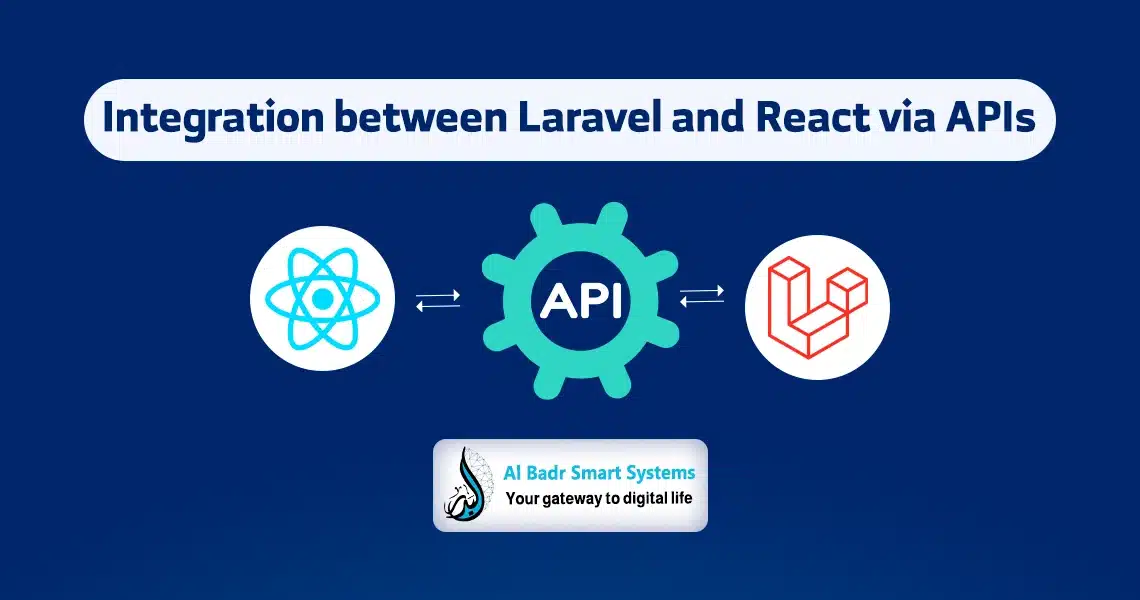
When unifying Laravel and React, the client-side interface requires a structured communication layer to exchange data with backend servers. This is achieved through RESTful API endpoints, where Laravel handles incoming data requests, executes database operations, and returns JSON payloads that React renders dynamically for the end user.
For example, in an e-commerce application, React presents product catalog grids to visitors. When a user requests filtered results, React dispatches an asynchronous call to the server; Laravel processes the query against the database and returns structured JSON datasets to update the view instantly.
Decoupling backend services from frontend views brings structural efficiency to website development workflows. Frontend and backend teams can build, refactor, and scale their respective codebases independently without disrupting overall system integrity, provided API request contracts remain consistent.
This decoupled architecture also prepares enterprise platforms for future expansion, such as native mobile app deployment, where mobile interfaces consume the same API endpoints managed by Laravel.
Performance and Efficiency Analysis
In modern website development, operational efficiency extends beyond raw page-load metrics to encompass server processing speeds and user experience consistency.
Backend Efficiency: Laravel
Laravel optimizes server-side data processing and system scalability through advanced architectural mechanisms:
- Server Processing and Caching: While PHP is not inherently as fast as bare-metal runtimes like Go, Laravel achieves high processing speeds via advanced caching layers, asynchronous job queues, and optimized database queries powered by Eloquent ORM.
- System Scalability: Laravel scales horizontally across cloud server environments, managing large volumes of concurrent user sessions smoothly with dedicated management tools like Laravel Horizon.
- Out-of-the-Box Features: Native authentication suites, security middleware, and file storage abstractions significantly reduce custom engineering timelines during backend website development.
Frontend Efficiency: React
React delivers high efficiency by optimizing browser rendering cycles and client-side responsiveness:
- Client-Side Velocity: Utilizing the Virtual DOM, React updates only altered UI elements, minimizing browser reflows and reducing interface latency.
- SPA Optimization: In Single Page Applications, initial page structure loads once; subsequent interaction data is fetched asynchronously in the background, creating a seamless browsing flow.
- Component Reusability: Modular component structures eliminate redundant UI code across complex web platforms, accelerating long-term website development cycles.
Summary: Direct performance comparisons are unproductive because Laravel optimizes backend processing, while React elevates frontend user experience. Maximum structural efficiency in modern website development is achieved when both frameworks operate in tandem.
Development Velocity and Project Delivery Schedules
Project completion timelines depend heavily on product scope, system complexity, and developer expertise. However, tech stack selection directly impacts daily engineering velocity.
Laravel includes pre-built modules for recurring backend tasks, such as user management, database migrations, input validation, and security routing, which shortens backend construction cycles significantly.
React provides a structured component framework that streamlines frontend construction across large-scale projects featuring repetitive interactive elements.
When combining Laravel and React, engineering teams manage two distinct codebases, requiring additional coordination during API integration phases. For simpler web applications, a single full-stack technology reduces operational complexity. However, for complex enterprise systems, a decoupled architecture pays off in scalability and long-term maintainability.
Learning Curve and Code Maintainability
Learning Curve
- Laravel: Moderate to accessible. PHP developers adapt quickly due to clear documentation, intuitive syntax, and structured framework rules.
- React: Moderate to steep. Requires a thorough understanding of modern JavaScript (ES6+), state management paradigms, and component lifecycle behaviors.
Maintainability
- Laravel: High. Strict adherence to MVC architecture and built-in testing suites ensures long-term backend maintainability.
- React: High. Component isolation simplifies debugging and updates without affecting surrounding UI architecture.
Code Organization
- Laravel: Expressive Eloquent syntax and native architectural guidelines encourage clean, readable codebases.
- React: Explicit data-flow patterns and modular component boundaries promote structured frontend development.
Security, Data Infrastructure, and User Management
Security is a fundamental priority in website development, particularly for applications processing payment transactions, personal user credentials, or sensitive business records.
Laravel provides built-in enterprise security mechanisms, including Cross-Site Request Forgery (CSRF) protection, SQL injection prevention via Eloquent PDO bindings, encrypted session storage, and fine-grained access control policies. This pre-configured infrastructure reduces the need to engineer foundational security tools from scratch.
React operates entirely within the client’s browser environment and should never be relied upon as a primary security boundary for sensitive data processing. Role management, data validation, and transaction authentication must be enforced strictly on the backend via Laravel.
Ultimately, overall system security relies on proper server configuration, robust database architecture, and strict access controls rather than choice of framework alone.
Community Ecosystem and Developer Support
Both ecosystems benefit from global developer communities that contribute to long-term software stability:
- Laravel Community: Supported by a large PHP community, Laravel offers a wide array of official packages (such as Nova, Forge, and Vapor) that simplify application deployment, server management, and cloud scalability during website development.
- React Community: Backed by Meta and an extensive open-source community, React maintains a vast library ecosystem. With over 42.62% of global developers utilizing React, finding qualified engineers for frontend website development remains straightforward.
Project Costs and Long-Term Scalability
Development costs vary based on functional requirements, screen counts, third-party integrations, and team expertise. Using Laravel independently for small-to-midsize projects keeps initial development budgets manageable by consolidating the technology stack.
For platforms requiring real-time interface responsiveness, incorporating React increases upfront frontend engineering investment, but provides greater flexibility as the system grows.
Decoupling backend logic from frontend presentation allows each layer to scale independently. When introducing mobile apps or expanding service lines, developers can reuse existing Laravel API endpoints without rebuilding core business logic.
At Al Badr Smart Systems, tech stacks are selected based on precise business objectives and operational requirements, ensuring every software investment balances performance, security, and long-term maintainability.
Selecting the Right Stack for Your Business
To determine the most efficient technology strategy for your website development project, evaluate your core business requirements:
Choosing the most suitable tool for your project:
- Content Platforms & CMS: Websites where fast initial server rendering and search engine optimization (SEO) outweigh complex real-time interactivity.
- Enterprise Backends: Software requiring complex server-side business rules, background job processing, and high-security user permission structures.
- Unified API Hubs: Scalable backend architectures engineered to serve data across multiple client applications, mobile platforms, and web portals.
Choose React When Building:
- Interactive SPAs & Dashboards: Platforms requiring instant client updates, live data streams, and zero-page-reload workflows.
- Complex Web Applications: Interfaces featuring reusable graphical components, interactive media editors, or dynamic data tables.
- Cross-Platform Ecosystems: Projects where frontend web components share architectural principles with React Native mobile applications.
The Hybrid Approach: Combining Laravel and React
For maximum efficiency, software architects often combine Laravel’s secure, API-driven backend with React’s dynamic frontend rendering. This decoupled approach delivers:
- High Performance: Combines Laravel’s secure server processing with React’s client-side velocity.
- Operational Flexibility: Enables backend and frontend teams to build, test, and release code independently, accelerating overall website development workflows.
FAQ about website development
Can I complete a full website development project using Laravel without React?
Yes. Laravel includes the Blade templating engine, allowing developers to build complete, server-rendered web applications efficiently. This approach is ideal for blogs, corporate portals, and standard content management systems that do not require heavy client-side interactivity.
How does React improve user experience (UX) in modern website development?
React leverages a Virtual DOM to update modified UI components dynamically without triggering full page reloads. This eliminates screen flickering, minimizes latency, and delivers a fast, responsive user interface comparable to native desktop applications.
Why is Laravel preferred for security in e-commerce website development?
Laravel features built-in security protections against common web vulnerabilities, including CSRF attacks, SQL injection, and XSS exploits. It also offers encrypted data storage and robust user authorization frameworks out-of-the-box, making it a reliable engine for sensitive financial transactions.
Premier Software Engineering Services – Al Badr Smart Systems
In enterprise software engineering, true efficiency comes from knowing how to balance and integrate complementary technologies effectively. That is where Al Badr Smart Systems delivers distinct technical expertise as a leading partner for digital product engineering and website development.
We evaluate every software initiative independently, crafting tailored technical architectures that balance performance, security, and scalability:
Resilient Backend Infrastructure with Laravel
We architect secure, scalable backend foundations tailored for high-concurrency environments. Leveraging Eloquent ORM, background job queues, and intelligent caching strategies, our backend implementations handle heavy transaction volumes reliably, whether powering large-scale e-commerce platforms or enterprise management suites.
Dynamic Frontend Interfaces with React
Our frontend team crafts fast, responsive user interfaces powered by React. Focusing on component reusability, optimized state management, and minimal rendering latency, we build Single Page Applications (SPAs) that deliver intuitive browsing experiences across all devices.
Seamless API Integration
We build robust RESTful APIs in Laravel to feed dynamic React frontends securely. Decoupling backend business logic from frontend presentation layers ensures easier system maintenance, smoother feature expansion, and seamless integration with future mobile applications.
Final Recommendation
Both Laravel and React have earned their places as essential tools in modern software development. Laravel provides secure, structured server infrastructure, while React delivers fast, interactive client-side interfaces.
Determining which option is more efficient depends on recognizing how both tools can work together: combining Laravel’s backend security and processing efficiency with React’s frontend speed and UI responsiveness.
If your organization requires a high-performance web platform built for speed, security, and future growth, investing in a unified technology stack guided by experienced software engineers is the surest path forward. Partner with Al Badr Smart Systems to turn your technical requirements into a secure, scalable, and market-ready digital product.
